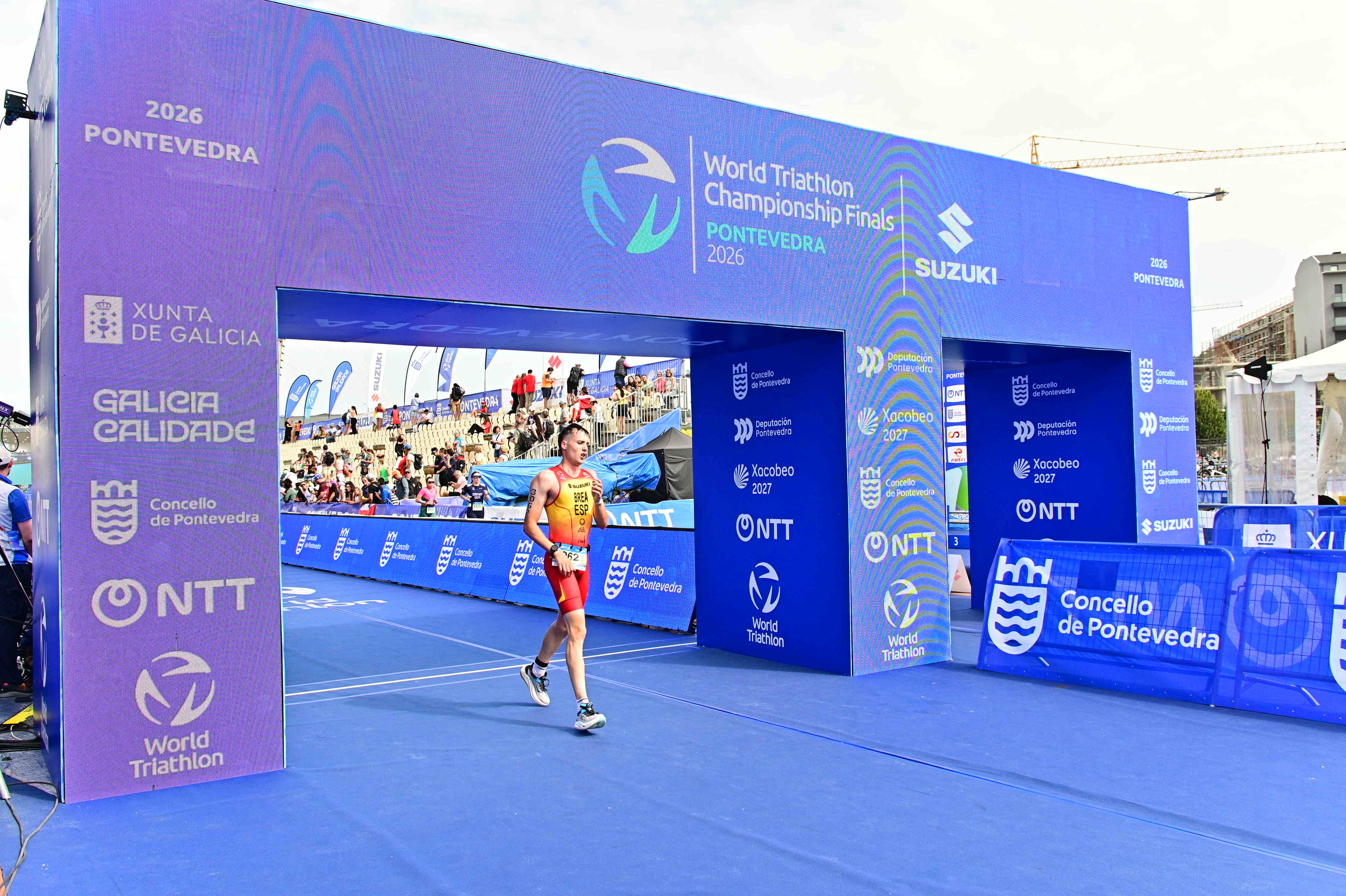
There is something different about competing under a flag. For most of the year, you train for yourself. You wake up early, put in the hours, deal with the bad sessions, the small injuries, the days when your body does not want to cooperate. You know why you are doing it. But then, for a few days, your name is followed by something else. A country. A flag. Something that is bigger than you.
This year, that flag was Spain. The World Triathlon Championship Final Series came to Pontevedra on September 2026, and I had the opportunity to compete there as a Spanish athlete. There was something special about racing a world championship in the place you have born, surrounded by people who speak your language, on roads and streets that do not feel foreign. But wearing Spain across your chest also changes the way you look at the race. You are still racing for yourself, but you are no longer carrying only your own name.
The standard triathlon race on Saturday was supposed to be a test of everything that had been built over the months before it. Training had led to this moment. The goal was not to win the world championship, but I believed a top thirty was within my level if I could put together the race I knew I was capable of. Instead, the race became a reminder of how little control we sometimes have over the outcome.
The swim started well. I was with the front group and everything was moving in the right direction until I took a hard hit to the stomach. It disrupted my breathing and changed the rest of the swim. From there, I had to settle down and simply get through it. The problem was not that the race suddenly became impossible. It was that the race I had imagined was gone, and there was nothing I could do to bring it back.
I finished the race in 49th place. On paper, that is all the result says. 49th. A number among hundreds of athletes who had come from all over the world. But numbers are very good at hiding everything that came before them. They do not show the months of training, the mornings when getting out of bed was difficult, the sessions that went badly, the days when something hurt, or all the small decisions that eventually make it possible to stand on a start line like that.
A result is real, but it is not the whole story. Sometimes the race simply does not give you the opportunity to show everything you have. The only thing left to do is accept it and come back the next morning.
The mixed relay was different because this time I was not racing only for myself. There were four of us, each with our own responsibility, and the result would belong to all of us. Natalia started the race and gave us a strong advantage. Antonio took the second leg and defended it. Then came Sonia, who was already carrying the fatigue of the previous day and, on top of that, was dealing with a fever. She was not at her best, but she still got in the water and did her part.
By the time I received the relay, the race was still open. The podium was there. We had something to fight for. I knew that some of the people before me had given everything they had, and that meant there was no room for thinking about how tired I was. The only useful thing was to move forward.
Until the bike, things were still going our way. We had an advantage over the Canadian team, and when I came off the bike it was still there. Then, with around 500 metres left in the run, the Canadian athlete passed me.
I tried to respond immediately. I pushed harder, then harder again. I tried to accelerate and close the gap, but there was no more speed there. The distance remained. I could feel the finish getting closer while knowing that the podium was moving further away. I kept pushing until the line, but I could not catch him.
We finished fourth in the world in our category. There is something uncomfortable about finishing fourth. The podium is close enough that you can see exactly what you missed, but far enough that nobody remembers how close it felt. There is no medal for almost. There is no alternative version of the result in which the last 500 metres go differently. The Canadian athlete was faster when it mattered, and that was the race.
For a few minutes afterwards, it was easy to think about what could have been different. What if I had had more left in my legs? What if I had responded earlier? What if I had run differently? What if the gap had been slightly smaller when I got off the bike? But sport does not work with what if. Eventually, you have to accept the result you have and decide what you are going to do with it.
And there is another side to fourth place. There were four athletes on that relay. Natalia created the advantage. Antonio defended it. Sonia raced while sick. And I fought until the finish. None of us got the podium we wanted, but all four of us left knowing that we had carried our part of the race.
I used to think that representing your country was mostly about the result. About standing on a podium, hearing an anthem, seeing a flag raised above the others. Those moments are obviously special, but the longer I think about it, the less I believe that is what carrying a flag really means.
You carry it when things go well, but you also carry it when they don't. You carry it when the swim goes wrong. You carry it when your legs are tired. You carry it when someone on your team is sick and still decides to race. You carry it when you have 500 metres left and someone passes you. And you carry it when you know you cannot change the result anymore but you keep pushing anyway.
Because representing something is not only about what happens when everything works. It is also about how you behave when it doesn't. There is no guarantee that the work you put in will produce the result you wanted. There is no guarantee that the race will be fair in the way you imagined it. Sometimes you prepare for months and lose something in a few seconds. Sometimes you are one position away from the podium and there is simply nothing left in your legs.
The flag does not become less meaningful because the race went badly. If anything, those are the moments when carrying it means the most.
There is a tendency to reduce sport to numbers. Time. Position. Watts. Pace. Seconds. Rankings. They are useful because they tell us what happened, but they cannot always tell us what something meant. Finishing 49th at a world championship is objectively different from finishing on the podium, but neither number can explain what it took to get to the start line in the first place.
The same is true of the relay. Fourth place is not third. I cannot change that, and I do not want to pretend otherwise. But the result does not erase the experience of racing alongside three other people, of watching the advantage being built before me, of knowing that someone was trusting me with the final leg, and of giving everything I had left when the race came down to the final 500 metres.
Maybe this is one of the harder lessons in sport. You can control the preparation, the effort, the attitude and the way you respond to adversity. You cannot control the exact moment when someone hits you in the swim. You cannot control how your body feels the next morning. You cannot control whether another athlete has more left in their legs. At some point, the only thing that remains yours is the way you carry yourself through it.
On Saturday, I carried the flag alone. On Sunday, I carried it with three other people. For two days, my name was followed by the same three letters: ESP. I did not bring home an individual result that reflected what I had hoped to achieve, and we did not bring home the relay medal that was within reach. But for a few days, I had the privilege of representing my country at a world championship.
That is something I do not want to reduce to a result.
Because you do not carry a flag only when you are winning. You carry it when things go wrong. You carry it when the work is not rewarded in the way you expected. You carry it when someone else is depending on you. You carry it when there are 500 metres left and you are already empty, but you still try to find something more.
You carry it all the way to the finish.
And then, whatever the result says, you hand it back knowing that you carried it as far as you could.
- A. R. Brea, written 29 Sep 2026