OSINT: what the web says about you without you knowing
Borges imagined a library that contained every possible book. The problem was never access: it was knowing how to read. The web resembles that library more than we tend to admit. Almost everything is already published, in the open, for anyone to consult, and the difficulty is no longer finding information but knowing what to ask of it. This talk is about open source intelligence, OSINT, and about one skill in particular: learning to look at what is already in plain sight.
Eighty years of listening in the open
OSINT is not a product of the internet. In 1939 the BBC set up a service to listen to enemy public radio and read its press; the United States created its own in 1941. In 1942, Allied statisticians estimated German tank production from the serial numbers on captured parts, and came remarkably close to the real figures. Seventy years later, Bellingcat geolocated publicly posted photographs to investigate MH17, Syria and the Skripal case.
The method has barely changed: listen, collect, infer, verify. What changed is the volume. We all publish now, constantly, and most of it without deciding to.
What OSINT is not
Before anything else it is worth clearing up what this is not. Nothing is broken and nowhere is entered: there is no hacking. Nothing is read that was not published to be read: there is nothing illegal about it. There are no secret sources: the source is the open web. What is left is method, which is to say looking with intent at what is already visible.
The map that revealed what it should not have
In 2018 Strava published a global heatmap built from the training routes of its users. It did not leak anything: the data was aggregated, anonymized and came from activity people had chosen to make public. But in remote areas, where almost nobody runs, the accumulated routes outlined the perimeter of military installations and, in some cases, suggested how they were laid out inside.
This is the clearest example I know of what the discipline actually does. Nobody attacked a system. Public data, context and analysis were enough.
A photograph is never just a photograph
During the talk I went through a photograph published on X by the Spanish Prime Minister in October 2026, and the readings that circulated publicly in the hours that followed: a covered front camera, blurred fingertips, a delay between the moment captured and the moment published, a screen photographed rather than captured, a dual SIM, two devices of different makes. Six observations from a single image.
Two caveats matter here, and I made them on stage. None of this is confirmed: they are inferences by third parties, and more than one could be a coincidence. And the point of the example is the opposite of a reproach, because whoever took that photograph did almost everything right. That is precisely what makes it useful: even a careful image says more than its author intended.
The method fits in four questions. What device is this? When, exactly? What surrounds the subject? And what is not visible, and why? The last one tends to be the most productive: absence informs. What is seen is a fact; what is deduced is a hypothesis, and the two should not be confused.
The web explains itself
The second half was a live demo on a public site. The browser hands over the HTML, the network requests, the routes and the APIs, because it needs them in order to render the page: inspecting is not attacking. Certificate Transparency does something similar at another level. Every certificate issued is recorded in public, auditable logs, by design, so that nobody can cheat, and that list reveals the subdomains an organization has asked for. I may not know what sits behind staging, but I know it exists, and that already says something about how that organization works.
The transparency that protects the web is the same transparency that makes it legible. This happens to all of us: a portfolio, an indexed PDF, an API that returns more than it should, old assets still in production. We all do OSINT without calling it that. The difference is doing it with method.
Conclusion
The practical takeaway is not to close the web, which would be neither possible nor desirable. It is to look at your own first: review images before publishing them, pay attention to what is actually in the frame and not only to the metadata, check what really reaches the browser, remember that hidden in the interface is not the same as non-existent, and audit your own site from the outside now and then.
OSINT is not about looking for secrets. It is about reading what is already in plain sight. The web talks; the question is whether we know how to listen to it.
Bibliography
The origins: listening in the open
-
Imperial War Museums. BBC Monitoring Collection: translation and open source. Oral histories of the service set up in 1939.
iwm.org.uk
-
Mercado, Stephen C. FBIS Against the Axis, 1941–1945: Open-Source Intelligence From the Airwaves. Studies in Intelligence, CIA.
cia.gov
-
Ruggles, Richard and Brodie, Henry. An Empirical Approach to Economic Intelligence in World War II. Journal of the American Statistical Association 42 (1947). The original paper on the serial numbers.
accessible summary
Strava, 2018
-
The Guardian, 29 January 2018. Coverage of the heatmap and the military installations it outlined.
theguardian.com
-
Strava. Global Heatmap. The map itself, still public.
strava.com
Method
-
Human Rights Center, UC Berkeley, and OHCHR. Berkeley Protocol on Digital Open Source Investigations. The reference standard for working with open sources as evidence.
humanrights.berkeley.edu
-
Bellingcat. Online Investigation Toolkit. A maintained catalogue of tools, by type of investigation.
bellingcat.gitbook.io
-
Higgins, Eliot. We Are Bellingcat (2021). How a group of civilians built an open source investigation method.
-
Bazzell, Michael. Open Source Intelligence Techniques. The practitioner's manual; the companion site keeps the links updated.
inteltechniques.com
The web as a source
-
Certificate Transparency. How the public certificate logs work and why they exist.
certificate.transparency.dev
-
crt.sh. Search those logs by domain; this is what I used in the demo.
crt.sh
-
Google. Chrome DevTools documentation. The network, sources and application panels, explained from scratch.
developer.chrome.com
The literary frame
-
Borges, Jorge Luis. La biblioteca de Babel, in Ficciones (1944). Where the talk starts: the library that contains everything, and the problem of reading it.
You can view the slides here.
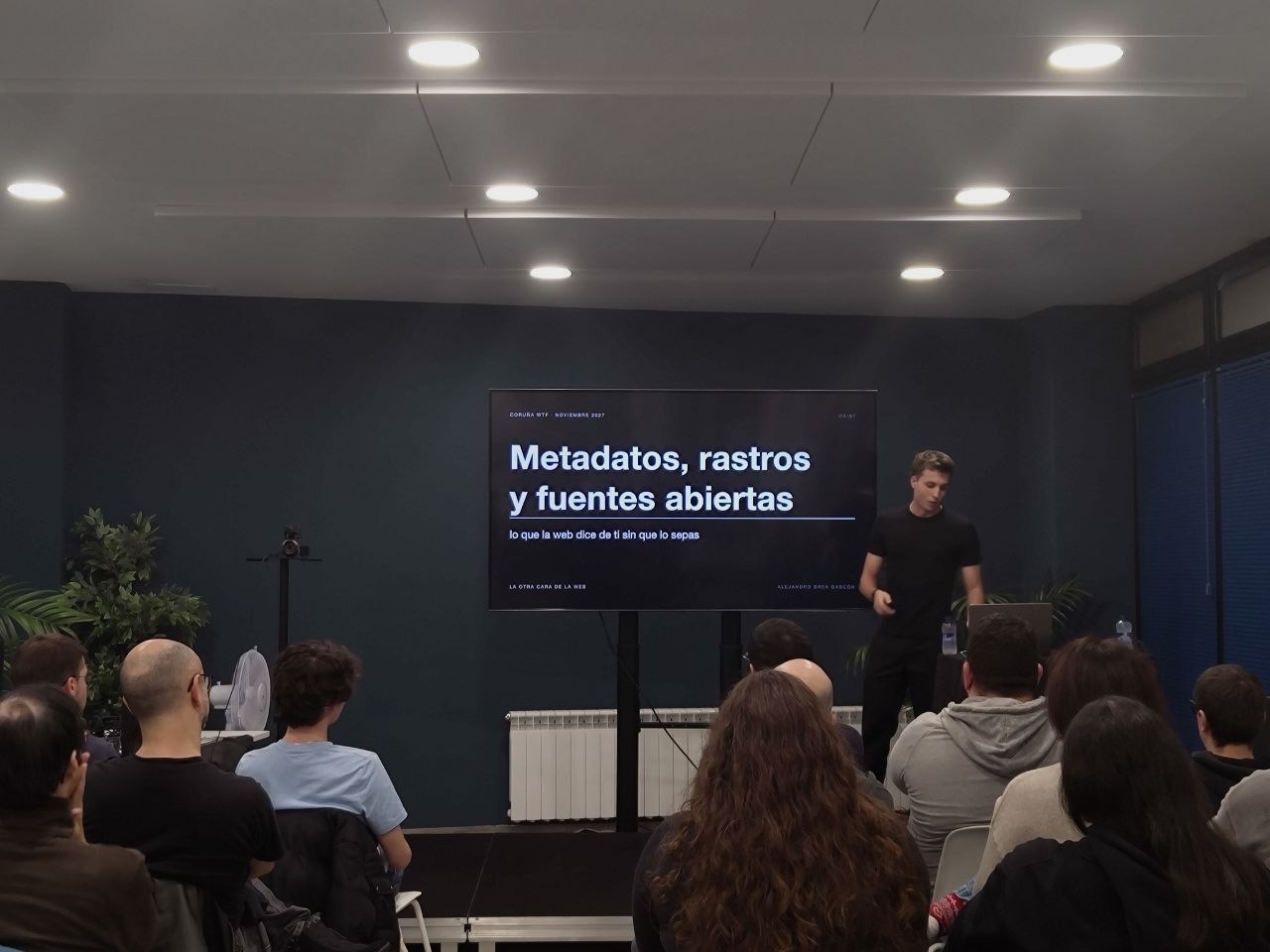
- A. R. Brea, written 13 Nov 2026
OSINT: lo que la web dice de ti sin que lo sepas
Borges imaginó una biblioteca que contenía todos los libros posibles. El problema nunca fue el acceso: fue saber leer. La web se le parece más de lo que solemos admitir. Casi todo está ya publicado, en abierto, a disposición de cualquiera, y la dificultad ya no es encontrar información, sino saber qué preguntarle. Esta charla va de inteligencia de fuentes abiertas, OSINT, y de una habilidad en concreto: aprender a mirar lo que está a la vista.
Ochenta años escuchando en abierto
OSINT no es un producto de internet. En 1939 la BBC montó un servicio para escuchar la radio pública del enemigo y leer su prensa; Estados Unidos creó el suyo en 1941. En 1942, los estadísticos aliados estimaron la producción alemana de tanques a partir de los números de serie de las piezas capturadas, y se acercaron notablemente a las cifras reales. Setenta años después, Bellingcat geolocalizó fotografías publicadas por cualquiera para investigar el MH17, Siria y el caso Skripal.
El método apenas ha cambiado: escuchar, recopilar, inferir, verificar. Lo que cambió es el volumen. Ahora publicamos todos, constantemente, y la mayor parte sin decidirlo.
Lo que OSINT no es
Antes de nada conviene aclarar qué no es esto. No se rompe nada ni se entra en ningún sitio: no hay hacking. No se lee nada que no se publicara para ser leído: no tiene nada de ilegal. No hay fuentes secretas: la fuente es la web abierta. Lo que queda es método, es decir, mirar con intención lo que ya está visible.
El mapa que reveló lo que no debía
En 2018 Strava publicó un mapa de calor mundial construido con los recorridos de entrenamiento de sus usuarios. No filtró nada: los datos estaban agregados, anonimizados y procedían de actividad que la gente había elegido hacer pública. Pero en zonas remotas, donde casi nadie corre, las rutas acumuladas dibujaban el perímetro de instalaciones militares y, en algunos casos, dejaban intuir cómo estaban distribuidas por dentro.
Es el ejemplo más claro que conozco de lo que hace realmente esta disciplina. Nadie atacó ningún sistema. Bastaron datos públicos, contexto y análisis.
Una foto no es solo una foto
Durante la charla repasé una fotografía que el presidente del Gobierno publicó en X en octubre de 2026, y las lecturas que circularon públicamente en las horas siguientes: una cámara frontal tapada, las yemas de los dedos difuminadas, un desfase entre el momento capturado y el momento de publicación, una pantalla fotografiada en vez de capturada, una doble SIM, dos dispositivos de marcas distintas. Seis observaciones a partir de una sola imagen.
Aquí importan dos matices, y los dije en el escenario. Nada de esto está confirmado: son inferencias de terceros, y más de una podría ser casualidad. Y el sentido del ejemplo es el contrario de un reproche, porque quien hizo esa foto lo hizo casi todo bien. Precisamente por eso resulta útil: incluso una imagen cuidadosa dice más de lo que pretendía su autor.
El método cabe en cuatro preguntas. ¿Qué dispositivo es este? ¿Cuándo, exactamente? ¿Qué rodea al sujeto? ¿Y qué no se ve, y por qué? La última suele ser la más productiva: lo ausente informa. Lo que se ve es un hecho; lo que se deduce, una hipótesis, y conviene no confundirlos.
La web se explica sola
La segunda mitad fue una demo en directo sobre una web pública. El navegador entrega el HTML, las peticiones de red, las rutas y las APIs porque los necesita para pintar la página: inspeccionar no es atacar. Certificate Transparency hace algo parecido en otro plano. Cada certificado emitido queda registrado en listas públicas y auditables, por diseño, para que nadie haga trampas, y ese listado revela los subdominios que una organización ha pedido. Puede que no sepa qué hay detrás de staging, pero sé que existe, y eso ya cuenta algo sobre cómo trabaja esa organización.
La transparencia que protege la web es la misma que la hace legible. Y esto nos pasa a todos: un portfolio, un PDF indexado, una API que devuelve de más, assets viejos que siguen en producción. Todos hacemos OSINT sin llamarlo así. La diferencia es hacerlo con método.
Conclusión
La conclusión práctica no es cerrar la web, que ni se puede ni interesa. Es mirar la propia primero: revisar las imágenes antes de publicarlas, fijarse en qué se ve y no solo en los metadatos, comprobar qué llega de verdad al navegador, recordar que oculto en la interfaz no es lo mismo que inexistente y auditar de vez en cuando tu propio sitio desde fuera.
OSINT no es buscar secretos. Es leer lo que ya está a la vista. La web habla; la pregunta es si sabemos escucharla.
Bibliografía
Los orígenes: escuchar en abierto
-
Imperial War Museums. BBC Monitoring Collection: translation and open source. Testimonios orales del servicio que se montó en 1939.
iwm.org.uk
-
Mercado, Stephen C. FBIS Against the Axis, 1941–1945: Open-Source Intelligence From the Airwaves. Studies in Intelligence, CIA.
cia.gov
-
Ruggles, Richard y Brodie, Henry. An Empirical Approach to Economic Intelligence in World War II. Journal of the American Statistical Association 42 (1947). El trabajo original sobre los números de serie.
resumen accesible (en inglés)
Strava, 2018
-
The Guardian, 29 de enero de 2018. Cobertura del mapa de calor y de las instalaciones militares que dejaba ver.
theguardian.com
-
Strava. Global Heatmap. El mapa en sí, que sigue siendo público.
strava.com
Método
-
Human Rights Center, UC Berkeley, y ACNUDH. Berkeley Protocol on Digital Open Source Investigations. El estándar de referencia para trabajar con fuentes abiertas como prueba.
humanrights.berkeley.edu
-
Bellingcat. Online Investigation Toolkit. Catálogo mantenido de herramientas, ordenado por tipo de investigación.
bellingcat.gitbook.io
-
Higgins, Eliot. We Are Bellingcat (2021). Cómo un grupo de civiles construyó un método de investigación en abierto.
-
Bazzell, Michael. Open Source Intelligence Techniques. El manual de referencia práctico; la web del libro mantiene los enlaces al día.
inteltechniques.com
La web como fuente
-
Certificate Transparency. Cómo funcionan los registros públicos de certificados y por qué existen.
certificate.transparency.dev
-
crt.sh. Buscador sobre esos registros por dominio; es el que usé en la demo.
crt.sh
-
Google. Documentación de Chrome DevTools. Los paneles de red, fuentes y aplicación, explicados desde cero.
developer.chrome.com
El marco literario
-
Borges, Jorge Luis. La biblioteca de Babel, en Ficciones (1944). De donde arranca la charla: la biblioteca que lo contiene todo y el problema de saber leerla.
Puedes ver las diapositivas aquí.
- A. R. Brea, escrito el 13 nov 2026
Go back